
An imagined glass data center with luminous roots connecting a town, gardens, school and clinic
Editorial metaphor. The structure below is an illustrative proposal, not an operating investment offering.
ImpactSoul · Data center tokenization and community ownership

The cloud has roots.
Give the community a stake.

The people beneath the infrastructure deserve more than a thank-you plaque. What if they owned a piece of the future they help make possible?

I’m an OG in this business, with roots going back to March 1996. Now I’m diving into the ownership layer because I want the thing to work: for the developer, for the investor and for the people living beside the power cord. This is a proposed piece of core infrastructure for the conscious compute era of distributed wealth. A community should be able to inspect its rights, follow its payments and keep its voice when the asset changes hands.

We are figuring out the sequencing: community authority, documented rights, a funded purchase, one discounted 1% tranche, verified operations and distributions, then possible resale to eligible buyers. Expand toward 10% only as the evidence and agreements support it. A broader float up to 30% is a separate option. The ambition is shared prosperity. The work is making every link in that chain hold.

See the 90/10 idea ↓Download the financial poster ↗
Community entry · 1% at a time, up to 10%

A smaller doorway.
A lasting voice.

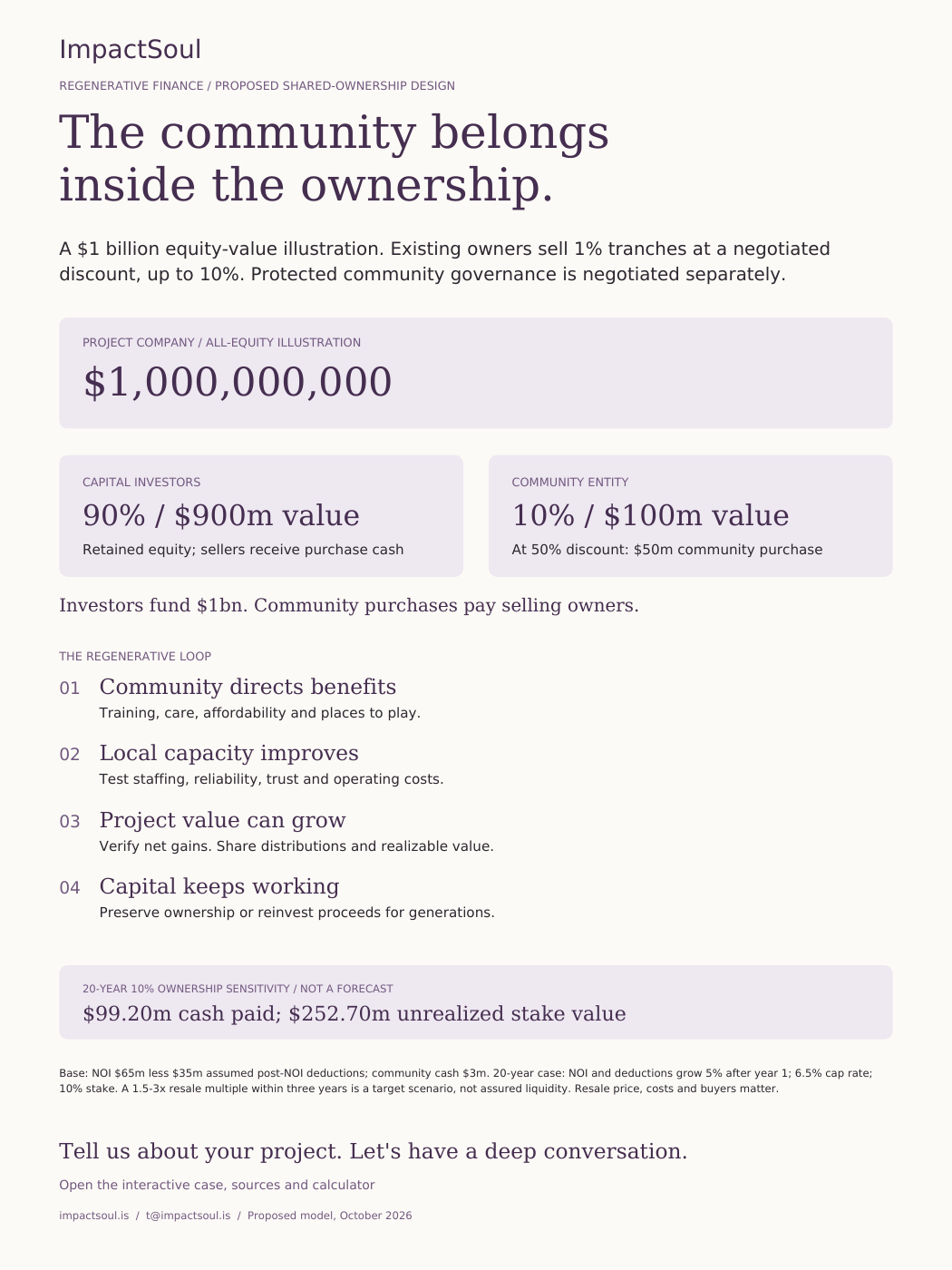
Existing owners first fund the $1 billion project. They then sell existing equity to an eligible community vehicle at a negotiated discount: one percentage point of the whole project at a time, up to 10%. These purchase payments go to the selling owners, not into the project’s construction budget.

At a $1 billion modeled equity value, each 1% has a proportional value of $10 million. At a 50% discount, the community vehicle pays $5 million per tranche. Ten tranches cost $50 million for a modeled $100 million interest. The owners retain 90% plus the $50 million sale proceeds. The $50 million discount is a real economic concession, not costless money.

Community participation is a purchase here, not the earlier grant model. Buyers need funding and can lose money. Separately funded public benefits must not depend on residents risking their savings.

90 / 10After all ten tranches
Investor / community equity

Ownership can trade. The community voice should endure.

Negotiate a protected community governance seat and defined authority over community benefits separately from transferable financial units. Specify selection, reserved decisions, independent advice, conflicts, enforcement, successors and amendment protections. A perpetual ambition needs documents that explain what survives a unit sale, refinancing, asset sale or dissolution.

A broader project float could reach 30%, including the community allocation, if owners and financing arrangements permit. It is an optional ceiling for a separate transfer program, not the community target and not an automatic token issuance.

Ownership grows. Earnings flow. Keep them distinct.

A growing business.
A growing community stake.

One percent is a beginning, not ten identical boxes. Watch the community acquire another percentage point while the business grows. The pie shows who owns the project in the selected year. The cash flow shows what that ownership receives.

All inputs are illustrative assumptions, not verified project accounts. Year-one revenue defaults to $100 million; it is not a sourced industry benchmark. Illustrative timing: the first 1% closes at the start of year one; another 1% closes at the start of each selected interval, up to the allocation ceiling in the calculator (default 10%). Each tranche is priced at that year’s modeled value and the selected purchase discount. No retroactive distributions. Revenue, operating costs and post-NOI deductions grow at the same rate. Change NOI, deductions, cap rate, allocation ceiling and purchase discount in the calculator.

Year 10 · who owns the project?

10%community
Community 10%Existing owners 90%

Community stake: $155.13m of $1551.33m modeled equity value.

The community percentage is ownership, not a share of gross revenue. A protected governance voice is negotiated separately from tradable equity.

Year 10 · follow the cash

Revenue$155.13m
Less property operating expenses$54.30m
Net operating income (NOI)$100.84m
Less post-NOI deductions$54.30m
Cash available for distributions$46.54m
Community · 10%$4.65m
Existing owners · 90%$41.89m

Post-NOI deductions include assumed entity-level taxes, capital spending and reserves. Cash available is not accounting net profit. No debt, depreciation or full income statement is modeled. The SEC explains why profit and cash flow differ. Payments require approved distributions.

Two changes, one timeline.

Green is the existing owners’ annual cash; purple is the community’s. The upper line shows total revenue, on its own labeled chart. The community’s cash share rises as tranches close, then holds at the allocation ceiling.

Year 11%
Year 55%
Year 1010%
Year 2010%

Community ownership at each milestone · default annual 1% allocation, capped at 10%.

Revenue · $ millions0941892830306191Annual distributions · $ millions15101520YearCommunityExisting ownersRevenue · $ millions0941892830306191Annual distributions · $ millions15101520YearCommunityExisting owners
Community cash paid through selected year$22.27m
Community purchase payments through selected year$62.89m
Community equity value · unrealized$155.13m

Through year 10, the community has acquired 10%, paid $62.89m to sellers and received $22.27m in modeled distributions. Its $155.13m retained stake is a separate, unrealized value; a buyer and permitted sale are required to turn it into cash.

Purchase payments go to selling owners and are separate from operating distributions. Cash paid minus purchase payments is a cash balance, not total investment return: it excludes the retained stake, financing costs, transaction costs and taxes. Growth does not come from issuing a token; it is an operating assumption to test.

YearCommunity ownershipRevenueCash availableCommunity annual cashCommunity stake value
11%$100.00m$30.00m$0.30m$10.00m
22%$105.00m$31.50m$0.63m$21.00m
33%$110.25m$33.08m$0.99m$33.08m
55%$121.55m$36.47m$1.82m$60.78m
1010%$155.13m$46.54m$4.65m$155.13m
2010%$252.70m$75.81m$7.58m$252.70m

Download this scenario’s annual calculations

From first issuance to changing hands

A sellout is a milestone.
A market is a relationship.

Issue the interest

Define the rights, eligible holders, funding and supply. Here: ten million total equity units and a target grant of three million tokenized units to the community entity. At $1 billion total equity value, the modeled value is $100 per unit. That is a valuation reference, not cash raised from residents.

Close the allocation

In this model the granted 30% is allocated to the community entity; no public token sale or demand-based pricing ladder is assumed. If a separate permitted offering is designed, its issuance closes when its available allocation is placed. Demand may remain, disappear or change. A sellout alone does not increase fair value.

Open eligible transfers

If the documents and law permit, willing holders can trade with eligible buyers. Orders, disclosures, settlement and actual transactions create price discovery.

Momentum needs more than scarcity.

Credible operating results can attract demand. More participants may improve trading depth. But prices can fall, spreads can widen and buyers can vanish. Secondary trades pay the seller, not the project or community budget, unless a separately disclosed mechanism says otherwise.

The community stake should not quietly leak away. Transfers must preserve its intended beneficiaries and governance. Liquidity for the investors’ retained conventional equity needs a separate permitted transfer arrangement.

A three-year ambition, with the arithmetic exposed

A discount is a head start.
A buyer is the finish line.

Target 1.5–3× the purchase price in net resale proceeds within three years. These are scenarios, not promised returns, buybacks or guaranteed liquidity. Proportional equity value is not a tradable quote. Eligible buyers, permitted transfers, actual demand and an executable price are essential.

Community purchase price · selected tranches$50.00m
Seller’s concession to modeled value$50.00m
Year-three net resale proceeds · 2% sale cost assumed$96.43m
Resale proceeds ÷ purchase price · distributions excluded1.93×

Selected 10% costs $50.00m. Year-three net resale = $100.00m × (1 + 5%)³ × (1 − 15%) × 98% = $96.43m. Sale cost is assumed at 2%.

Required equity values for 1.5× and 3× net resale proceeds: 1.5×: $0.900bn; 3×: $1.801bn. Deductions for actual taxes, custody, financing, entry costs and any transfer restrictions require project-specific review. Distributions are excluded from these resale multiples. Entry may occur at different dates and prices across tranches; this illustration prices all selected tranches together.

With no appreciation, no market haircut and no selling cost, a 50% purchase discount implies 2× proportional value. That is paper value, not available cash. No sale means no resale proceeds, regardless of the dashboard.

The regenerative loop

Let value grow roots.

Community voice
sets priorities
Investment supports
local capacity
Measure operating
benefits and harms
Shared ownership
participates in value

Better local conditions may improve retention, reliability or project delivery. That is a thesis to test, not a valuation premium to invent. Publish the baseline, costs, outcomes and disappointments. Consent cannot be bought with a dividend.

Turn the assumptions. Watch the economics.

What does the community actually receive?

Base case: $65 million annual net operating income, less $35 million of assumed entity-level taxes, capital spending, reserves and costs not already included in NOI. That leaves $30 million distributable. At the fully placed 10% allocation, community cash is $3 million and investor cash is $27 million.

NOI is not revenue. This simplified all-equity model has no debt service. NOI already deducts property operating expenses. The $35 million is an illustrative input, not sourced project accounts; do not deduct operating expenses twice. Cash distributions and unrealized equity value are different things.

Modeled gross asset value = equity value here (no debt)$1.00bn
Community equity value$100.00m
Annual community cash$3.00m
Each 1% of total project equity$10.00m
Investor annual cash after community allocation$27.00m
Unfunded cash shortfall before distributions$0.00m

Value: $65m ÷ 6.5% = $1000.00m. Cash before distributions: $65m − $35m = $30.00m. Community: $3.00m. Investors: $27.00m.

These are current-year results at the selected allocation ceiling. The phased timeline above starts at 1% and uses these starting NOI, deductions and cap-rate inputs, plus its own growth and allocation timing. A cap-rate change affects modeled value, not operating cash. Distributions require an approved policy.

Follow the dollar all the way to a life

A payment is a beginning.
What changes because of it?

The data center earns money. After expenses and reserves, part of the available cash goes to the community because it owns part of the project. The community decides what to fund. Then we check what happened.

This example uses year one, when the community owns 1%. It follows the calculator’s starting economics. The budget below is a proposed illustration, not money already paid or a program already operating.

  1. 01 · Earn

    The project makes cash available.

    $30.00m remains after property expenses and post-NOI deductions.

  2. 02 · Share

    Ownership sends a share home.

    1% of $30.00m = $300,000 for the community.

  3. 03 · Decide

    The community chooses.

    Its authorized representatives approve a budget, providers and spending rules. Local priorities lead. Tribal Nations determine their own participation.

  4. 04 · Fund

    Dollars reach the work.

    Release approved funds to named programs or eligible recipients. Record amounts, dates, fees and conditions.

  5. 05 · Verify

    Receipts meet real lives.

    Check delivery, completion and results. A transferred dollar is not proof of a person helped.

  6. 06 · Learn

    Publish. Challenge. Improve.

    Compare results with the starting point. Let residents challenge the record. Change the next budget when the evidence calls for it.

Where could the first $300,000 go?

Here is one possible budget. Community approval comes first. The proportions are illustrative; costs include assumed delivery and administration. Whole units are rounded down, with unused amounts retained in the same program budget.

Skills and a path to work

50%
$150,000

Could fund 25 training places at an assumed $6,000 per place.

What we checkEnrollment, completion and employment at 6 and 12 months. A funded seat is not a job guarantee.

Relief on household bills

30%
$90,000

Could fund 60 household assistance packages at an assumed $1,500 each.

What we checkEligible households actually reached, assistance delivered and changes in bill burden. This does not prove lower electricity prices.

A reserve for the next need

20%
$60,000

Held in the community reserve under approved custody and withdrawal rules. Not counted as services delivered.

What we checkVerified balance, fees, withdrawals and who approved them. No investment return is assumed.

$150,000 + $90,000 + $60,000 = $300,000. Every dollar has a destination.

What could run automatically?

After approved accounts and spending rules are in place: calculate the share, reconcile payment records, make authorized transfers and flag missing reports. Each payment needs approval limits, an audit trail and a way to stop errors.

What must remain human?

Consent. Priorities. Eligibility. Disputes. Decisions about whether a program helped. People supply and independently check the evidence; software can organize it.

This page is a model. It is not connected to project accounts, payment systems or an impact database. No transfers occur here. Automation is a proposed capability, not an installed system.

The public receipt should show more than a dollar sign.

MeasurePlanActual resultEvidence needed
Training25 funded placesNot yet measuredProvider records; completion and employment checks
Household assistance60 assistance packagesNot yet measuredVerified payments and anonymized household follow-up
Community reserve$60,000 retainedNot yet fundedCustodian statements and authorized withdrawals

Publish totals and verification methods, not people’s private records. Name the responsible provider, reporting date and independent reviewer. Include complaints and corrections. A dashboard with no evidence is a very expensive mood board.

Does a stronger community make a stronger asset?

That is our thesis. Test it. Track jobs and household benefits alongside project hiring, staff retention, community complaints, operating performance and independent valuations. Compare before and after, account for market changes and look for a fair comparison group.

Better community outcomes may support a stronger project. They do not automatically increase its price. If more cash is actually earned and approved for distribution, the community participates through its ownership. If the stake’s value rises, that remains a paper value until a permitted sale turns it into cash.

Bring your project. Let’s trace the dollars together.
Read the timeline correctly

More ownership is not the same as more growth.

A business can grow while the community percentage stays still. The community can acquire more ownership while the business value falls. This model lets both happen independently. The 10% ceiling is a target for participation, not a promise of returns.

The new timeline phases ownership in. The earlier financial poster and fixed-10% calculations are comparisons in which the community already owns the full 10% from year one. Their totals differ because ownership starts earlier. They must not be used as the results of this phased scenario.

Community drives asset value · the thesis to test

The community is part of the asset.
Put it in the deal.

Your project has a location. It also has neighbors, workers, schools and a future. If their prosperity helps the asset prosper, how will they participate in the value they help create?

Let’s examine data center tokenization, community ownership, enduring governance and transparent distributions against your actual project economics. Bring the numbers. Bring the people. Bring the difficult question.

Discuss your data center tokenization project

Email Tony Greenberg at t@ramprate.com. The button opens a prepared inquiry in your email app; review it and send when ready.

Start with location, development stage, financing, ownership and community priorities. Keep confidential documents out of the first message. Exploratory discussion, not an investment subscription. Community prosperity improving asset value is a thesis to measure, not a guaranteed valuation premium.

The argument has a history

From co-location to conscious compute.

I entered this industry in March 1996. Years spent examining suppliers, economics and contracts at RampRate bring me to this question: can the people who help create infrastructure value participate in its future? The historical appendix distinguishes my recollections from the published record. This proposal is the next question in that work.

The Second Mouse Gets the Cheese

Timing, judgment and who captures value in the AI infrastructure gold rush.

Read the mouse and cheese article

The Tollbooth and the Alternative

Stablecoins, access and the economics of moving money.

Read the stablecoin essay

Data Centers Have a Heart

The YOTTA experience and the community bargain behind this model.

Read the companion essay
Evidence before enthusiasm

The roots beneath the model.

Real project scale

Google announced a $1 billion UK data center investment. That supports scale, not this project’s valuation or a tokenization partnership.

Google’s announcement ↗

Resource wealth, shared

Alaska offers a precedent for saving resource wealth for future generations. Its Permanent Fund is not a 10% pipeline equity scheme.

Alaska Permanent Fund ↗

Rights remain rights

Tokenized securities remain subject to applicable securities law. Eligibility, custody and transfer rules belong in the design.

SEC staff statement ↗
Full financial assumptions, industry references and governance notes

Comparison only: the earlier 10% funded design

The live model above is a discounted sale of existing equity in 1% tranches, up to 10%, after owners fund $1 billion. This earlier reference uses a different financing arrangement: investors fund $900 million and a sponsor separately contributes $100 million for a 10% community stake. Do not combine its funding, percentages or returns with the discounted tranche model. Its numbers remain here for comparison.

DESIGN CASE · REAL REFERENCES, EXPLICIT PROPOSED TERMS

The billion-dollar building that brings its neighbors into the deal

Imagine a data center whose neighbors can point to an ownership stake, a public distribution record and decisions they control. This is a proposed ImpactSoul use case, not an existing transaction or a representation that ImpactSoul has already deployed these capabilities.

Start with numbers we can authenticate

Google announced a $1 billion investment at Waltham Cross on January 18, 2024. That establishes real project scale, not its market valuation or a tokenization partnership. Separately, Digital Realty’s July 2026 results reported a roughly $7.8 billion gross value for three fully leased Northern Virginia centers, with an expected initial stabilized capitalization rate above 6.5%. Different assets, different economics.

Below, $1 billion is a chosen project capitalization and opening valuation. The 6.5% rate is a simplifying model input informed by the published transaction reference, not that transaction’s exact rate or a valuation of Google’s facility. Ownership percentages, income, deductions and scenarios are proposed assumptions. No Google or Digital Realty participation is implied.

Proposed one-billion-dollar project: 90 percent investor ownership and 10 percent sponsor-funded community ownership, with contractual rights and transparent distributions
Proposed structure. 90% investor equity. 10% sponsor-funded community equity. Only the community stake is tokenized.

90% for capital. 10% for the community.

Opening capitalizationFundingOwnership unitsRights
Capital investors$900,000,0009,000,000 · 90%Pro rata equity economics, subject to agreed voting and transfer rules.
Sponsor contribution for a community entity$100,000,0001,000,000 · 10%The entity holds the stake for community benefit. Residents are not asked to invest their savings.
Total$1,000,000,00010,000,000 equity units at $100; 1,000,000 tokenizedAll-equity illustration: no debt or preferred claims.

The sponsor contributes the $100 million alongside investors’ $900 million. It is real funding with a real opportunity cost. The community entity receives the funded units; its initial $100 million modeled stake value is not $100 million of spendable cash. Future value can rise, fall or disappear.

The project company owns the property and operating interests. Only the community’s 10% interest is tokenized in this design: one million tokenized units at a $100 opening issue price. The remaining nine million units are conventional investor equity. The community tokens represent documented equity interests in that company, not direct title to a rack or a guaranteed entitlement to electricity. Governing documents determine rights, official ownership records, transfers and remedies. The SEC’s January 2026 staff statement explains that tokenized securities remain subject to securities law. Offering eligibility, administration and jurisdiction-specific implementation require qualified review.

Show the cash before showing the token

For a stabilized year, assume $65 million in net operating income. That is the model’s $1 billion valuation multiplied by 6.5%; it is not reported revenue. Assume a further $35 million for entity-level taxes, capital expenditures, reserves and disclosed costs not already included in NOI. No debt service is included.

NET OPERATING INCOME$65 million
POST-NOI DEDUCTIONS− $35 million
DISTRIBUTABLE CASH$30 million
INVESTORS · 90%$27 million
COMMUNITY · 10%$3 million

The $3 million is a modeled annual distribution, not a guaranteed payment. Publish every deduction, including ImpactSoul’s compensation if engaged. If distributable cash falls to zero, this equity distribution also falls to zero. Essential community services need separately funded, negotiated commitments; they should not depend entirely on investment performance.

The community-to-asset feedback loop

Community chooses and funds useful benefits

Test whether training, services and trust improve local conditions

Measure project effects: staffing, delays, reliability and operating costs

If net operating income improves, asset value may increase

Community ownership participates in distributions and realizable value

This is the ImpactSoul thesis to test. Community prosperity may strengthen a project through better workforce pathways, reliable services and constructive relationships. It does not establish a universal valuation premium. Measure costs as well as benefits, compare with a credible baseline and disclose adverse effects. Do not treat consent or sovereignty as something a payment purchases.

What improvement would mean in dollars

Illustrative scenarioAnnual NOICap rateGross asset valueCommunity’s 10% stake value
Opening model$65m6.5%$1,000.00m$100.00m
Net NOI improves by $2m$67m6.5%$1,030.77m$103.08m
Downside: lower NOI, higher cap rate$55m7.5%$733.33m$73.33m

A $2 million net NOI improvement at a constant 6.5% cap rate implies approximately $30.77 million more gross asset value. The community’s 10% share of that increase is about $3.08 million. The additional $3.08 million is unrealized equity value. Separately, with deductions held at $35 million, the extra $2 million NOI increases annual community cash by $200,000. Equity value becomes cash only through a permitted realization event, not a dashboard update. The improvement is hypothetical and cannot be attributed to community investment without evidence.

The downside matters too: $55 million NOI at 7.5% implies a $266.67 million decline from the opening value, including about $26.67 million less modeled community stake value. Tokenization does not remove operating or valuation risk.

Use the single live calculator above. Gross asset value = NOI ÷ cap rate. In this all-equity model, gross asset value equals modeled equity value. Community value = 10% × equity value. Community cash = 10% × max(0, NOI − deductions after NOI). If deductions exceed NOI, show the shortfall rather than treating it as an operating success.

Alaska: turn today’s resource into tomorrow’s wealth

Alaska offers a real precedent for the ambition: preserve part of resource revenues, invest them and use earnings to support people across generations. The Alaska Permanent Fund Corporation explains that at least 25% of state mineral royalties enter protected principal, rising by statute to 50% for leases issued after 1979. This is an invested state fund, not residents owning that percentage of a pipeline.

APFC reported $88.9772 billion of fund value on August 31, 2026, unaudited. Alaska’s Department of Revenue identifies the 2026 dividend and energy-relief payment as $1,200 per eligible recipient. The payment and fund balance are different measures: one is current cash, the other is capital kept working.

The lesson is intergenerational participation. It is not evidence that every Alaskan supports the pipeline, nor a guarantee that a data center will deliver comparable results. An ImpactSoul community entity would have a negotiated project equity stake; Alaska’s fund receives resource revenues and invests a diversified portfolio. The mechanisms differ, but both point toward benefits that extend beyond an opening ceremony.

Ten percent of the journey, not one year’s leftovers

The community’s proposed 10% is an enduring equity interest: participation in declared profit distributions and the organization’s realizable equity value, according to its agreements. The modeled $3 million is one starting year’s cash distribution. It is neither the lifetime benefit nor a ceiling. If earnings grow, payouts may grow. If the organization becomes more valuable, the community participates through its continuing stake.

Here is a transparent 20-year sensitivity. Assume annual NOI and post-NOI deductions both grow 5% after the first stabilized year, the cap rate stays at 6.5%, and the community retains an undiluted 10% stake. Starting distributions are $3 million; starting community stake value is $100 million. These are nominal-dollar assumptions, not forecasts, Alaska return estimates or proven effects of community investment.

YearCommunity annual cashCumulative cash paidCommunity stake value · unrealized
Year 1$3.00m$3.00m$100.00m
Year 5$3.65m$16.58m$121.55m
Year 10$4.65m$37.73m$155.13m
Year 20$7.58m$99.20m$252.70m

In this growth scenario, 20 years produce approximately $99.20 million of cumulative community distributions, while the retained stake has a modeled year-20 value of $252.70 million. The stake is not cash. A sale at that modeled value could realize it, less transaction costs and applicable liabilities. Adding distributions and sale proceeds would include the original $100 million funded stake; it must not all be described as profit.

At zero growth, the same starting distribution would total $60 million over 20 years and the modeled stake would remain $100 million. Losses, dilution, additional capital needs, weaker demand, technology obsolescence or a higher cap rate can reduce both streams. A durable structure preserves rights and reinvestment rules; it cannot promise returns forever.

Download the 20-year assumptions and annual calculations. Use actual project accounts, capital needs and approved distribution policy before underwriting a real transaction.

Make the benefit outlive the founder

The proposed community entity keeps its equity interest through a transfer of other investors’ units. A sale of the underlying property instead requires a written waterfall: expenses and senior claims first, then the entity’s contractual share of net proceeds. Its governing rules can direct reinvestment into an endowment or another qualifying asset. That is a route to durable benefit, not a promise of perpetual income.

Define protections against dilution, amendment and diversion; elected community representation; conflict disclosures; independent financial review; and a practical process for complaints and remedies. The community controls its benefit budget. Qualified operators remain responsible for safety and daily operation. Tribal participation and rights must be determined by the Nation itself.

For ImpactSoul, the proposed role is to help design and coordinate ownership records, reporting and distribution with qualified legal, financial, technology and community partners. Publish the cost, who can change the rules, what happens if the platform fails and how records and payments continue without it. The community’s rights cannot depend on our website staying awake.

The test is a life, not a token

Show actual payments. Show who made the decisions. Show which lives improved and which costs increased. Track the project’s economics separately, then test the connection. A beautiful feedback loop becomes credible when someone can follow the money in both directions.

You are asking people to live beside a billion-dollar ambition. Give them a durable stake in what they help make possible.

THE INDUSTRY CONTEXT · VERIFIED OCTOBER 1, 2026

The rails exist. The bargain still has to be built.

Stablecoins, tokenized funds and real-world asset ownership solve different problems. This is a practical sequence of capabilities, not a claim that the whole industry developed in one straight line.

Stablecoins · move money

Circle’s USDC is a digital-dollar payment and settlement instrument. It can help move distributions where legally and operationally appropriate. Holding a stablecoin does not give someone ownership of a data center.

Tokenized funds · record financial interests

BlackRock’s BUIDL, offered through Securitize, is a real example of tokenized fund interests. Eligibility and fund terms govern access. It demonstrates financial infrastructure; it does not establish a market for private data center equity.

Real-world assets · attach the record to a right

RWA means real-world assets. A tokenized project interest needs a clearly identified issuer, asset, ownership record and enforceable rights. The SEC’s January 2026 staff statement distinguishes issuer-sponsored interests from third-party and synthetic structures.

Can developers become liquid over time?

Potentially, through permitted partial sales of their interests to eligible buyers. A transparent ownership register, financial reporting and transfer process can make those transactions easier to administer. Liquidity still needs a buyer, an agreed price, lawful access, an appropriate venue or bilateral process, and any required lender and issuer consents.

In our 90/10 case, only the community’s 10% interest is tokenized. The developer’s 90% is conventional equity, so community tokenization does not itself create developer liquidity. A separate, approved transfer program for investor equity would be needed. Additional tokenization would be a separate decision, not silently added to this model.

The community stake need not be sold to let the developer sell part of its own holding. Protect the 10% interest against dilution or removal of its rights. A sale of units, a property sale and refinancing are different events with different waterfalls.

The SEC’s September 2026 conditional trading exemption concerns tokenized National Market System stock. It is evidence of developing market infrastructure, not blanket permission to trade a private data center interest.

How easy is it?

The digital record can be the easy part. Agreeing on the rights is the work. Start with five decisions: identify the issuer and asset; settle the funded community allocation; agree governance and distribution rules; establish compliant administration and transfers; then pilot reporting and payments before scaling.

Each stage needs named owners and priced work. Costs and timing depend on jurisdiction, financing, investors and project readiness. No verified implementation budget or schedule exists for this proposed case. We should quote one after reviewing the project, not invent one for the brochure.

The regenerative finance test

Community benefit strengthens local capacity. Measure whether that capacity improves the project. Share realized value under visible rules. Preserve part of that value for the next generation. Repeat while the economics support it. Community prosperity driving asset value is a thesis to test, not a guaranteed premium.

Digital plumbing should help a promise survive. It should never become an excuse to make the promise harder to understand.

Return to the case and project invitation · Read the original essay